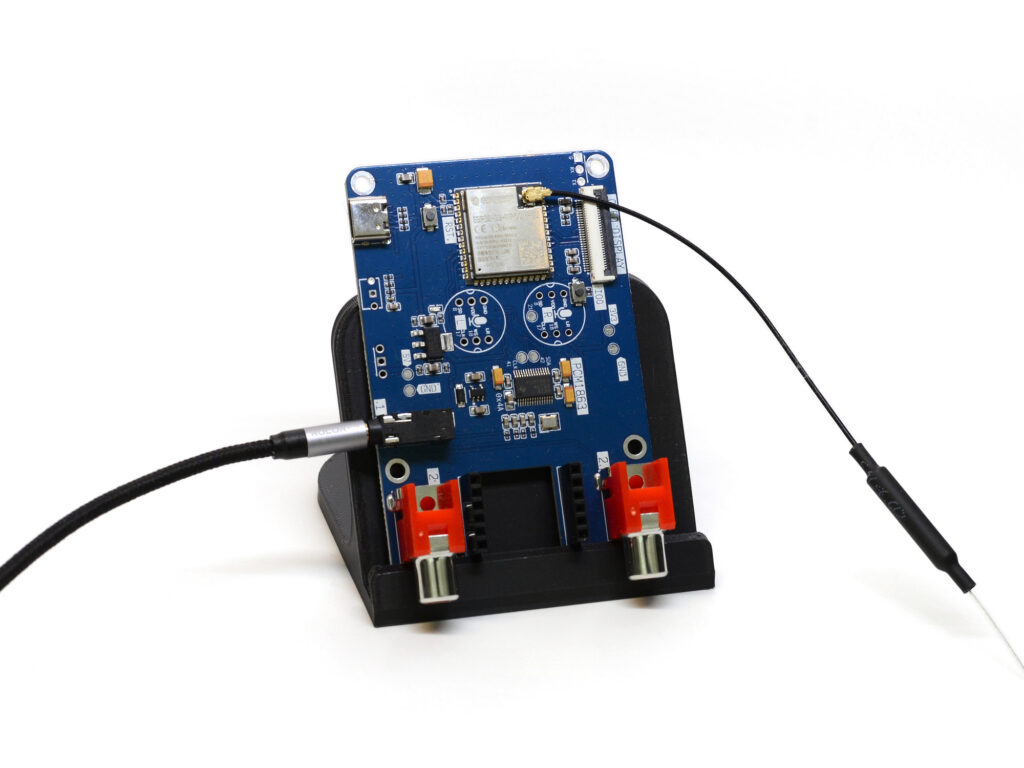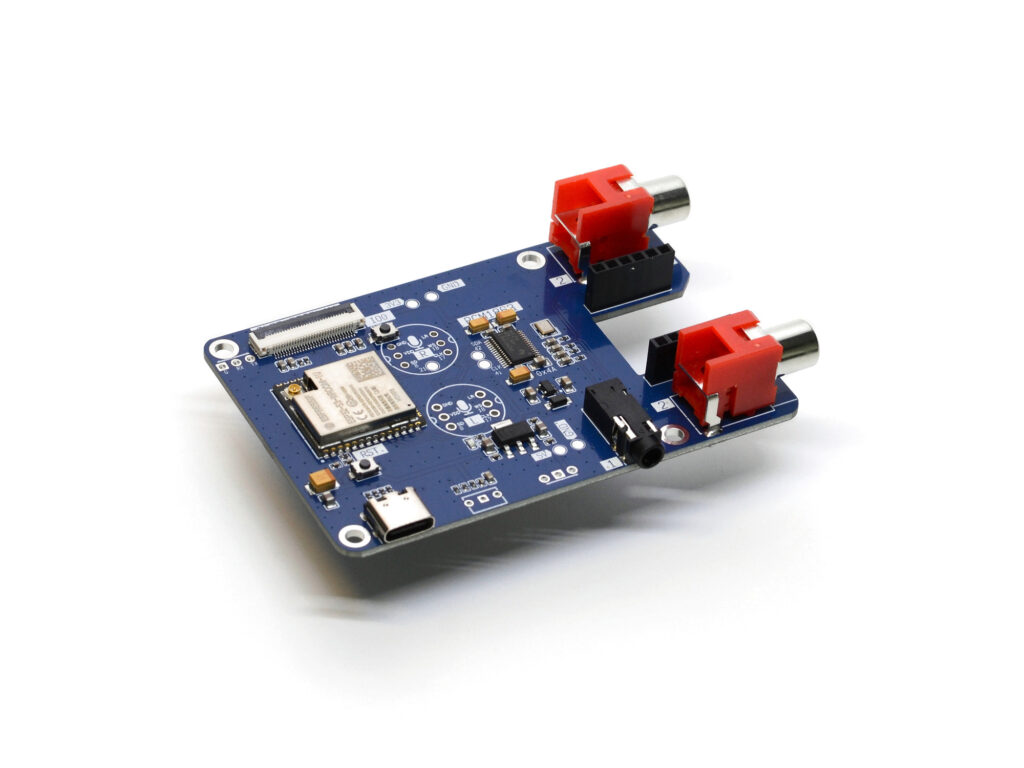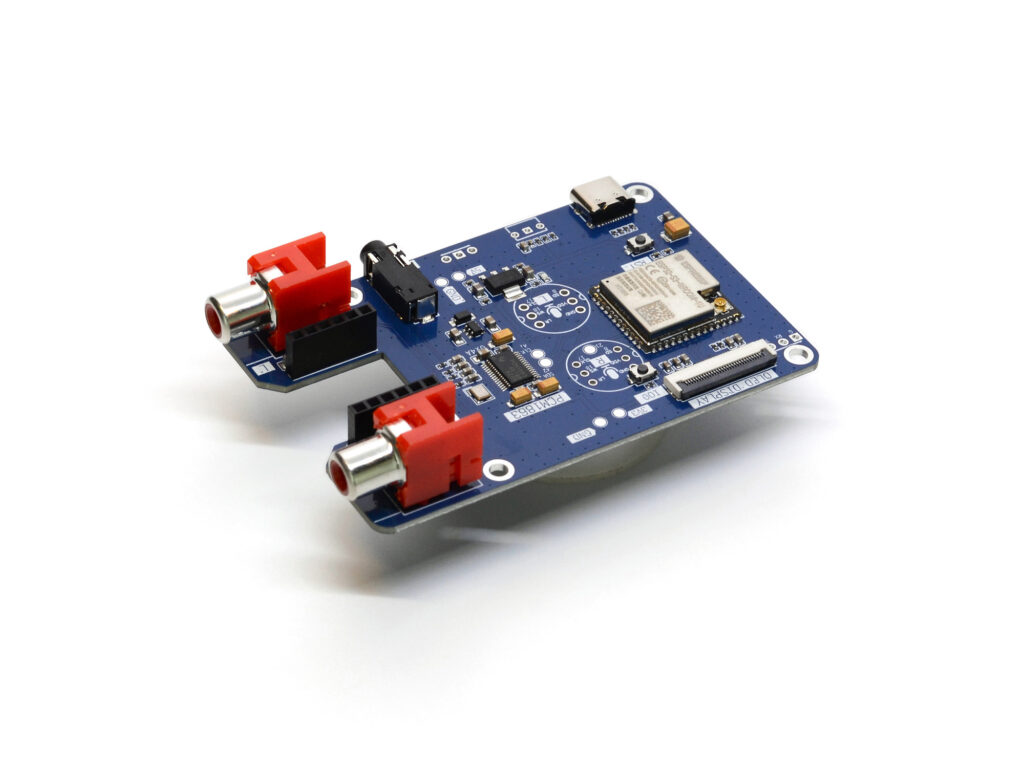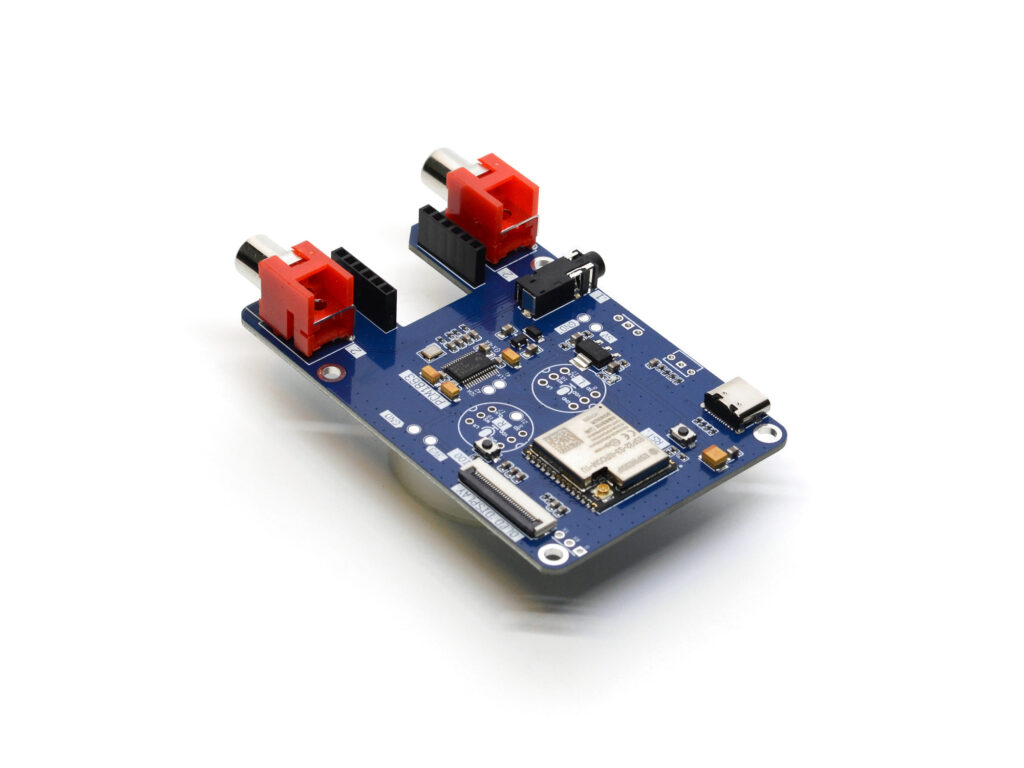
⚠️ First prototype. HiFi-ESP32-Input has been bench-tested end-to-end, but expect rough edges: the pinout, the firmware, and even the name may still change. The first boards are going to beta testers, and their feedback will shape the next batch.
Great for: Home Assistant & Music Assistant · compare all setups →
What is it?
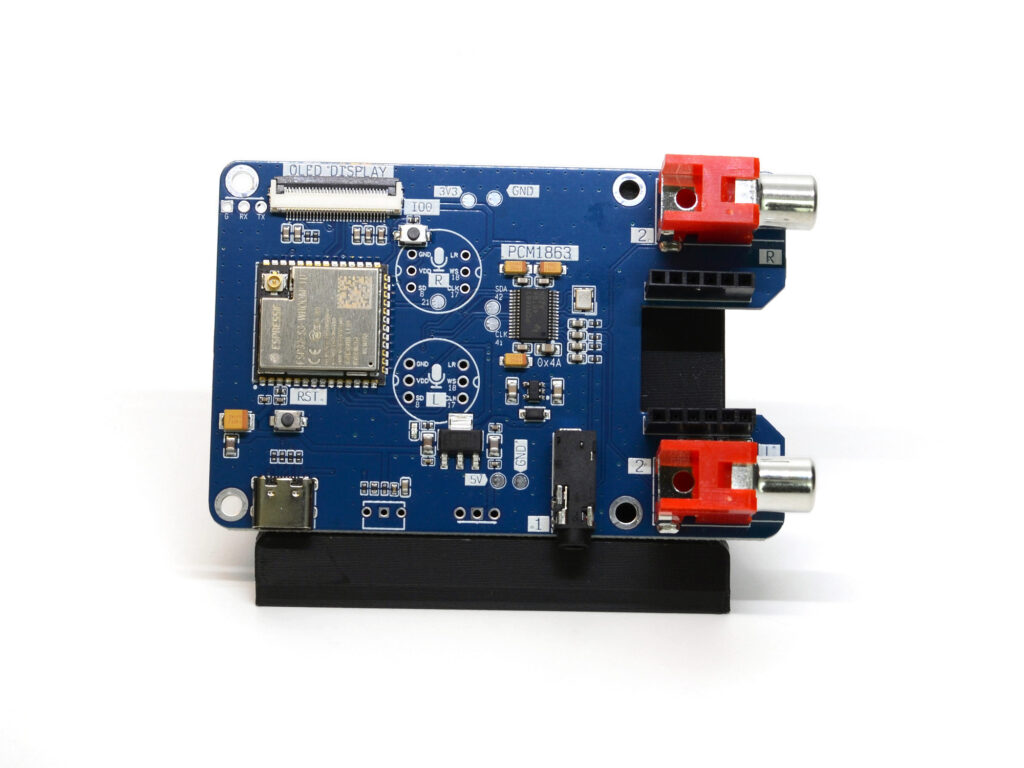
Every other board in the ESP32 Audio range turns a network stream into sound. HiFi-ESP32-Input goes the other way: it turns sound into a network stream. Plug in a turntable, a CD player, a tape deck or the headphone output of a TV, and it becomes a source in Music Assistant that you can play on any speaker or group in the house.
It is the HiFi-ESP32-Plus design with the PCM5122 DAC swapped for a PCM1863 stereo ADC, so instead of feeding an amplifier, it feeds your multi-room system.
Use cases
- A turntable, CD player or tape deck that should play on speakers in other rooms
- A TV’s headphone output, so the living room sound follows you around the house
- Any line-level source you would rather not re-cable every time you move it
Features
| MCU | ESP32-S3 (no classic ESP32 version) |
| ADC | PCM1863 24-bit stereo ADC, 110 dB SNR (A-weighted) |
| Inputs | 3.5 mm minijack and a pair of coax sockets (left and right), both line level and switchable at runtime |
| Full scale | 2.1 V RMS on the single-ended inputs |
| Gain | Programmable, −12 dB to +40 dB in 0.5 dB steps |
| Capture | 24-bit stereo at 48 kHz |
| Extras | IR receiver, optional OLED screen and W5500 ethernet same form factor as the rest of the HiFi-ESP32 line |
Three sockets, one board
Alongside the 3.5 mm minijack, two coax sockets carry a second analog stereo pair. All of them are wired to the ADC at once, and the Line Input setting on the device page switches between them while the board is running: no reflash and no re-cabling.
Note that the coax sockets are analog line inputs, not S/PDIF. A digital input is a different thing that needs its own receiver chip.
Firmware and Home Assistant
The board ships with ESPHome firmware that makes it a Sendspin source: the mirror image of the Sendspin player the other boards run. Flash it from the web installer, let Home Assistant discover it like any other Sonocotta device, and these appear on its device page:
| Entity | What it does |
|---|---|
| Line Input (select) | Picks the socket: VIN2 is the minijack, VIN1 the coax pair, NONE disconnects the input. |
| Line In Signal (switch) | Tells Music Assistant whether something is playing. Nothing on the board measures the level, so set it by hand or from an automation. |
| Sendspin Pairing Code (sensor) | Shows the code while Music Assistant pairs with the board, empty the rest of the time. |
| Unpaired Access (switch) | On by default, so a new board shows up straight away. Turn it off once your server has paired. |
In Music Assistant, the input shows up once the board has connected. If it asks for a code, read the Sendspin Pairing Code sensor and type it in. Then pick the input as the source on whichever player or group should play it.
Good to know:
- New software, too. It needs ESPHome 2026.11.0 or later and a Music Assistant version whose Sendspin support covers sources, not just players. Treat the combination as experimental.
- Set the gain per source. A turntable through a phono preamp and a TV headphone output sit at very different levels, so adjust the gain for each.
- No silence detection. The board streams whatever the selected input carries, including the noise of an empty socket. Select NONE to mute the capture.
What comes next
A digital input (S/PDIF over coax, and maybe optical) is being considered, likely as a separate board. Would you use one? Tell me what you would plug into it, on Discord or in a GitHub issue.
Documentation
Both software and hardware are fully open source: the schematic, PCB, BOM, gerbers, 3D model and ESPHome configs are on the project’s GitHub.
Where to buy
Not on sale yet. The first boards are going to beta testers; shop links are coming soon.
Sponsorship & Community Support
If you’re working on an open-source project, an educational initiative, or any pro-bono/volunteer effort, feel free to reach out for sponsorship details. I’ll do my best to provide discounts or even free boards.
Custom Design & Consultation
If you’re interested in a custom design based on or inspired by my boards, I also offer contract design work and consultation when needed.