
Put a Sonocotta Hat on any Raspberry Pi and it becomes a network streamer, a pair of powered speakers or a full 2.1 system. The Hat handles the sound; you choose the software — Volumio, moOde, piCorePlayer, or plain Raspberry Pi OS with Spotify Connect, AirPlay, Snapcast and Squeezelite.
- Fits every Pi: from the Zero 2 W to the Pi 5, using the standard 40-pin header
- One power supply: the amplifier Hats take a laptop-style adapter and power the Pi too
- Standard drivers: one line in
config.txtfor most Hats; a one-line installer for Louder - Room for more: 2.1 with a subwoofer, or up to 8 channels from a single Pi 5
- Open-source hardware: schematics, PCB files and setup scripts on GitHub
- Affordable: from $15 for a line-out Hat, $20 for a stereo amplifier
Raspberry Pi or ESP32?
Sonocotta makes both. They play the same music; the difference is how much computer you want behind your speakers.
| Raspberry Pi + Hat | ESP32 devices | |
|---|---|---|
| What it is | a small Linux computer with a sound card | a dedicated audio device |
| Starts up | boots like a computer, in about half a minute | in a few seconds |
| Software | any Linux audio software: Volumio, moOde, Snapcast, Spotify Connect, AirPlay, Squeezelite, UPnP, a music server | one firmware at a time, installed from the browser |
| Your music library | can store and serve it, with a music server on the same Pi | plays from a server or a phone |
| Sound tuning | CamillaDSP on any Hat; built-in DSP on Louder | built-in DSP on Louder devices |
| Extras | displays, IR remote, recording input, up to 8 channels | voice assistant, screens, Ethernet on some models |
| Best for | tinkerers, hi-fi streamers, an all-in-one music server | a speaker in every room, run by Home Assistant |
Choose a Pi Hat if you like to tinker, want a full audio OS like Volumio or moOde, or already have a Pi in the drawer. Want a speaker that just works with Home Assistant, AirPlay or Spotify? The ESP32 solutions are simpler and cheaper per room.
What you can build
A streamer for your amplifier
Line-level output for a receiver, an old hi-fi amplifier or powered speakers. HiFi Hat.
Speakers that play everything
Spotify Connect, AirPlay, Snapcast, Squeezelite and UPnP at once, driving passive speakers directly. Loud, Amped or Louder.
2.1 with a subwoofer
Two satellites and a subwoofer from one Hat, with the crossover done in the amplifier’s DSP. Louder 2X.
Vinyl and CD into the smart home
Record a turntable or CD player through the line input and stream it to every room. HiFi Plus Hat.
Several zones from one Pi 5
2X Hats use the Pi 5’s extra audio lines: two stereo zones per Hat, up to four when stacked. 2X versions.
Now playing, on screen
Dual OLED or TFT Hats show the track and VU meters; any Hat takes an IR remote. Display Hats.
Pick your Hat
Start with what it will plug into. Line-out Hats feed an amplifier; the others have the amplifier built in and connect straight to passive speakers.
| Hat | Plugs into | Output | Power | Sound tuning | From |
|---|---|---|---|---|---|
| HiFi | amplifier, receiver, powered speakers | line out, 2.1 V RMS | from the Pi | software (CamillaDSP) | $15 |
| HiFi Plus | the same, plus a turntable or CD player to record | line out + line/mic in | from the Pi | software; hardware volume | $20 |
| Loud | small passive speakers | 2×3 W (8 Ω), 2×5 W (4 Ω) | 5 V from the Pi, or a 5 V supply that feeds both | software (CamillaDSP) | $15 |
| Amped | passive speakers, and an amplifier later | 2×25 W (8 Ω) + line out | 8–26 V adapter, feeds the Pi | software (CamillaDSP) | $20 |
| Louder | full-size passive speakers | 2×22 W (8 Ω), 2×32 W (4 Ω) | 7–26 V adapter, feeds the Pi | ✅ built-in DSP: 15-band EQ, crossovers, PurePath files | $20 |
| Louder Plus | full-size passive speakers, more power | 2×32 W (8 Ω), 2×45 W (4 Ω) | 7–26 V adapter, feeds the Pi | ✅ richer built-in DSP, more efficient | $25 |
Prices are MSRP for a single unit; Lectronz, Tindie and Elecrow list volume pricing. Amplifier power is at 20 V, 1% THD+N.
1X or 2X?
- 1X is one stereo output and works with every Pi. Pick this unless you need more.
- HiFi, Loud and Amped 2X are for the Pi 5: two independent stereo outputs on one Hat. Stack two Hats for four zones — 8 channels. On older Pis both outputs play the same audio.
- Louder 2X and 2X Plus make a 2.1 system on any Pi: stereo satellites plus a bridged subwoofer channel (about 45–55 W), with Linkwitz-Riley crossovers in the DSP.
- 2X versions cost $5 more.
The Hats

HiFi Hat
A clean line-level output for the amplifier or powered speakers you already own. The PCM5100A DAC runs from an ultra-low-noise regulator, so nothing from the Pi reaches your speakers. Uses the standard HiFiBerry DAC driver, so every audio OS supports it.
HiFi Plus Hat
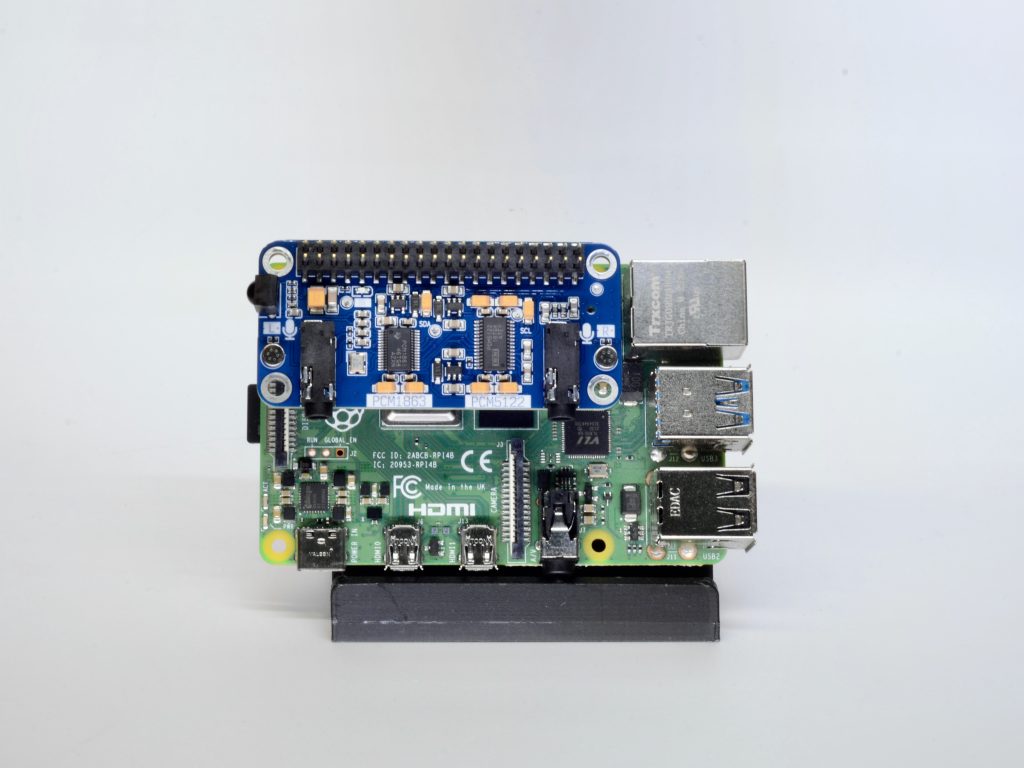
The HiFi Hat with a better DAC and a recording input. The PCM5122 adds hardware volume control, so quiet listening keeps full resolution, and the PCM1863 ADC takes a turntable preamp, CD player or microphone — ready to stream to the rest of the house. Similar in function to the HiFiBerry DAC+ ADC and uses the same driver.

Loud Hat
The simplest way to get sound from a Pi into a pair of small speakers. Two MAX98357A amplifier chips deliver a few watts per channel and switch off completely when idle, so there is no hiss at night.
Amped Hat
A HiFi DAC and a real amplifier on one Hat: drive passive speakers now and keep a line out for a sub or an amplifier later. It needs only the standard HiFiBerry driver, so it is as easy to set up as the HiFi Hat. One adapter powers the amplifier and the Pi.


Louder Hat and Louder Hat Plus
The most capable Hat, for full-size speakers. Its TI TAS5805M (Plus: TAS5825M) amplifier has a signal processor built in, and the Sonocotta driver controls it live from ALSA: a 15-band parametric EQ, subwoofer and satellite crossovers, mixer modes and gain, without rebooting. Designs from TI PurePath Console can be loaded at boot. The 2X versions turn one Pi into a complete 2.1 system.
Display Hats
Add a screen on top: the Dual OLED Hat carries two 1.3″ OLEDs, the Dual TFT Hat two 2.0″ colour screens. Show the track that is playing or a VU meter from CamillaDSP, using the common Adafruit, Pimoroni or luma Python libraries. About $5 each — see the display Hat notes.
Set it up
1. Fit and power
Press the Hat onto the Pi’s header. HiFi, HiFi Plus and Loud run from the Pi’s own USB supply; Amped and Louder take one adapter on the Hat that powers both.
2. Add the driver
Flash Raspberry Pi OS or DietPi, then add one line to /boot/firmware/config.txt (table below) and reboot. Louder Hats run a one-line installer first.
3. Choose your software
Install an audio OS, or keep Raspberry Pi OS and add just the services you want. See the options.
| Hat | Line in config.txt |
|---|---|
| HiFi, Amped | dtoverlay=hifiberry-dac |
| HiFi Plus | dtoverlay=hifiberry-dacplusadc |
| Loud | dtoverlay=max98357a — see the Loud notes for the enable pin |
| Louder | dtoverlay=tas58xx,i2creg=0x2d |
| Louder Plus | dtoverlay=tas58xx,i2creg=0x4c |
| Louder 2X / 2X Plus | dtoverlay=tas58xx-dual |
| HiFi, Loud, Amped 2X on a Pi 5 | dtoverlay=hifiberry-dac8x |
Louder driver installer (Raspberry Pi OS, 64-bit; a DietPi version is in the docs). Read the script before you run it:
curl -sL https://raw.githubusercontent.com/sonocotta/raspberry-media-center/refs/heads/main/firmware/cloud-init/configure-louder.sh | sudo bashSoftware that works
HiFi, HiFi Plus, Loud and Amped use drivers that ship with every Raspberry Pi audio distribution. Louder needs the Sonocotta driver, which installs on Raspberry Pi OS and DietPi.
| Software | What you get | HiFi · Loud · Amped | Louder |
|---|---|---|---|
| Raspberry Pi OS + Sonocotta playbooks | Spotify Connect, AirPlay, Snapcast server and client, Squeezelite, UPnP renderer, CamillaDSP with a web UI | ✅ | ✅ |
| DietPi | a lean base; add the same services from its software menu | ✅ | ✅ |
| Volumio | a polished player with a phone app | ✅ choose “HiFiBerry DAC” or “MAX98357” | ❌ the driver cannot be added at the moment |
| moOde, piCorePlayer, HiFiBerry OS | ready-made audio systems with web interfaces | ✅ | not tested |
Home Assistant and Music Assistant: run the Snapcast client or Squeezelite on the Pi and Music Assistant sees it as a player, synced with your other rooms. The Snapcast guide explains the setup — a Pi Hat joins the same group as the ESP32 speakers.
Questions
Which Raspberry Pi should I use?
A Pi Zero 2 W is enough for a player in one room. Choose a Pi 4 or Pi 5 if the same Pi will also run a music server, CamillaDSP filters or several zones. The 2X multi-zone Hats need a Pi 5.
What happened to the Media Center?
The cased Media Center versions are retired; Sonocotta now makes the Hats only. If you own one, it sets up exactly like the matching Hat — the GitHub documentation keeps the Ethernet, IR and RGB LED notes.
Can I tune the sound?
On Louder Hats the amplifier’s own DSP does it: a 15-band parametric EQ, crossovers for a subwoofer and satellites, and full TI PurePath Console designs, all controlled from ALSA. On any Hat, CamillaDSP (included in the playbooks) gives you software EQ and room correction.
My Louder Hat is not detected
A few boards answer on an address one off from the default. Run i2cdetect -y 1, then put the address it shows into the i2creg= setting. The docs walk through it.
Do the amplifier Hats get warm?
At high volume, yes. To fit the Hat size, Louder and Amped use compact output filters that run warmer than the full-size coils of the old Media Center. Give the Hat some air in a closed case.
Where can I buy?
EU stock ships from Tindie and Lectronz; worldwide shipping from Elecrow. Each device page links straight to its listings.
Each Hat above links straight to its listings.
Stuck? Ask
Come say hi on Discord, open an issue on GitHub, or email me — I read every message.